
The logistics sector is approaching a structural turning point. The conversation about autonomous freight has moved beyond speculation and into execution.
For years, industry projections suggested that autonomous trucking could displace as much as half of human-driven long-haul capacity by 2027. At the time, those forecasts sounded aggressive to many operators. Today, when you look at the pace of technological deployment, regulatory testing corridors, and fleet-level pilot programs, those projections appear less like speculation and more like a realistic trajectory.
Ten years ago, I authored a paper examining the strategic potential of autonomous freight systems. At that time, the concept sat on the edge of technological imagination. The sensors were improving, artificial intelligence was developing rapidly, and vehicle automation platforms were still being tested largely in controlled environments. The industry viewed it as an innovation story rather than an operational reality.
Fast forward to today and the equation has changed.
The hardware works.
The software works.
The sensor fusion systems work.
The routing intelligence works.
Autonomous freight platforms can now move goods across hundreds of miles with precision, consistency, and operational efficiency that rivals traditional human-driven systems in controlled lanes. Infrastructure corridors are being built specifically to support this technology. Logistics companies are testing driver-out models on fixed routes. Insurance frameworks and regulatory discussions are progressing. In short, the engineering barrier has largely been removed.
The remaining constraint is no longer technological.
It is human.
Adoption curves in logistics have always been shaped by culture, economics, and leadership decisions. The industry must now answer a series of uncomfortable but necessary questions:
• How do we integrate autonomous systems without destabilizing workforce ecosystems?
• How do carriers transition operating models built around human driver capacity?
• How do shippers redesign supply networks around 24/7 autonomous freight flows?
• How do regulators, unions, and corporations align incentives around a technology that fundamentally changes labor dynamics?
This is the real inflection point.
Not technology.
Not engineering.
Leadership.
The logistics industry is entering a phase where the organizations that adapt first will redefine cost structures, delivery speed, and supply network resilience for decades to come. Autonomous freight is not simply a trucking innovation. It is a supply chain architecture shift.
Think about what a truly autonomous freight network enables:
• Continuous 24-hour freight movement without driver rest constraints
• Reduced accident exposure driven by machine precision
• Lower long-term transportation costs
• Predictable transit times with AI-managed routing
• Supply chains designed around data rather than human availability
Those changes do not just impact trucking. They ripple through warehousing, retail distribution, manufacturing timelines, and global trade logistics.
The companies that prepare early will redesign their operating models around these advantages. The companies that wait will eventually be forced to react.
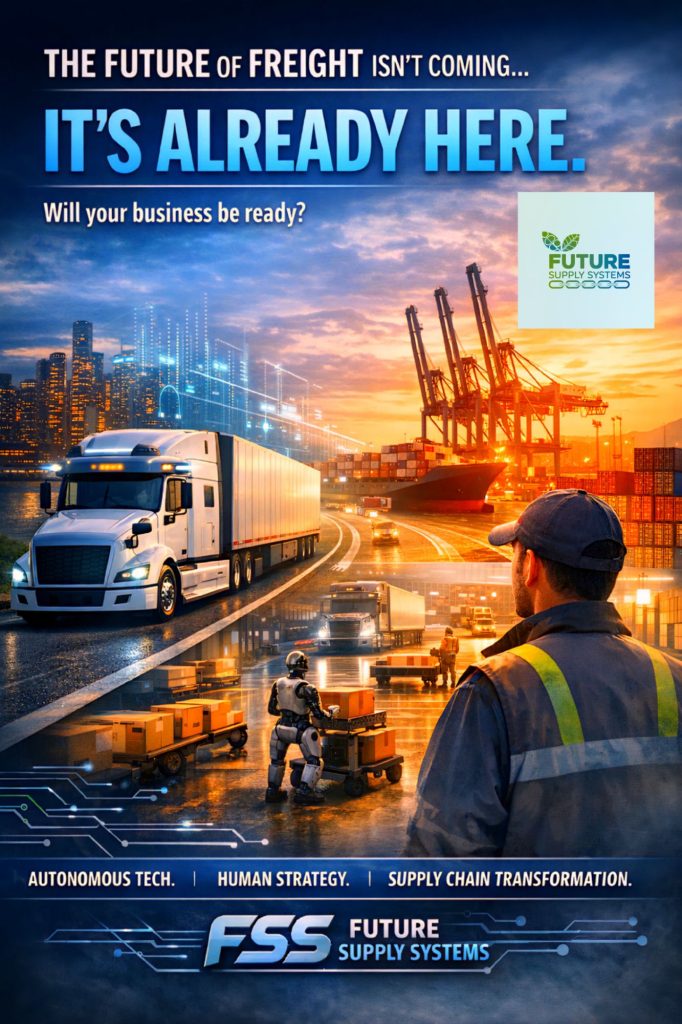
That is where Future Supply Systems enters the conversation.
Future Supply Systems exists at the intersection of operational readiness and human readiness. The technology is already here. What businesses need now is strategic alignment, transition planning, and leadership frameworks that help organizations integrate automation without losing operational stability.
Our role is straightforward but critical:
Translate innovation into executable logistics strategy.
Bridge the gap between emerging technology and real-world operations.
Prepare companies and institutions to operate inside the next generation of supply networks.
Because the reality is simple.
The future of freight is not something that will arrive someday.
It is already arriving.
The question for the logistics industry is not whether autonomous freight will reshape supply chains.
The question is who will be prepared when it does.
Leave a Reply